
The Seventh Word of The Words by Imam Said Nursi is one of the most concentrated explanations of the human condition in the early part of the Risale-i Nur. It focuses especially on belief in God and the Hereafter, and explains how these beliefs transform the way a person understands life, death, suffering, weakness, and the future.
Imam Nursi presents the whole discussion through a powerful soldier analogy.
Central Analogy: A Soldier in a Terrifying Situation
Imagine a soldier on a battlefield and examination ground.
He finds himself in an extremely difficult situation:
- He has two serious wounds.
- A terrifying lion is behind him.
- Ahead of him is a gallows, where he sees people he loves being taken away.
- He is also being sent on a compulsory journey into an unknown future.
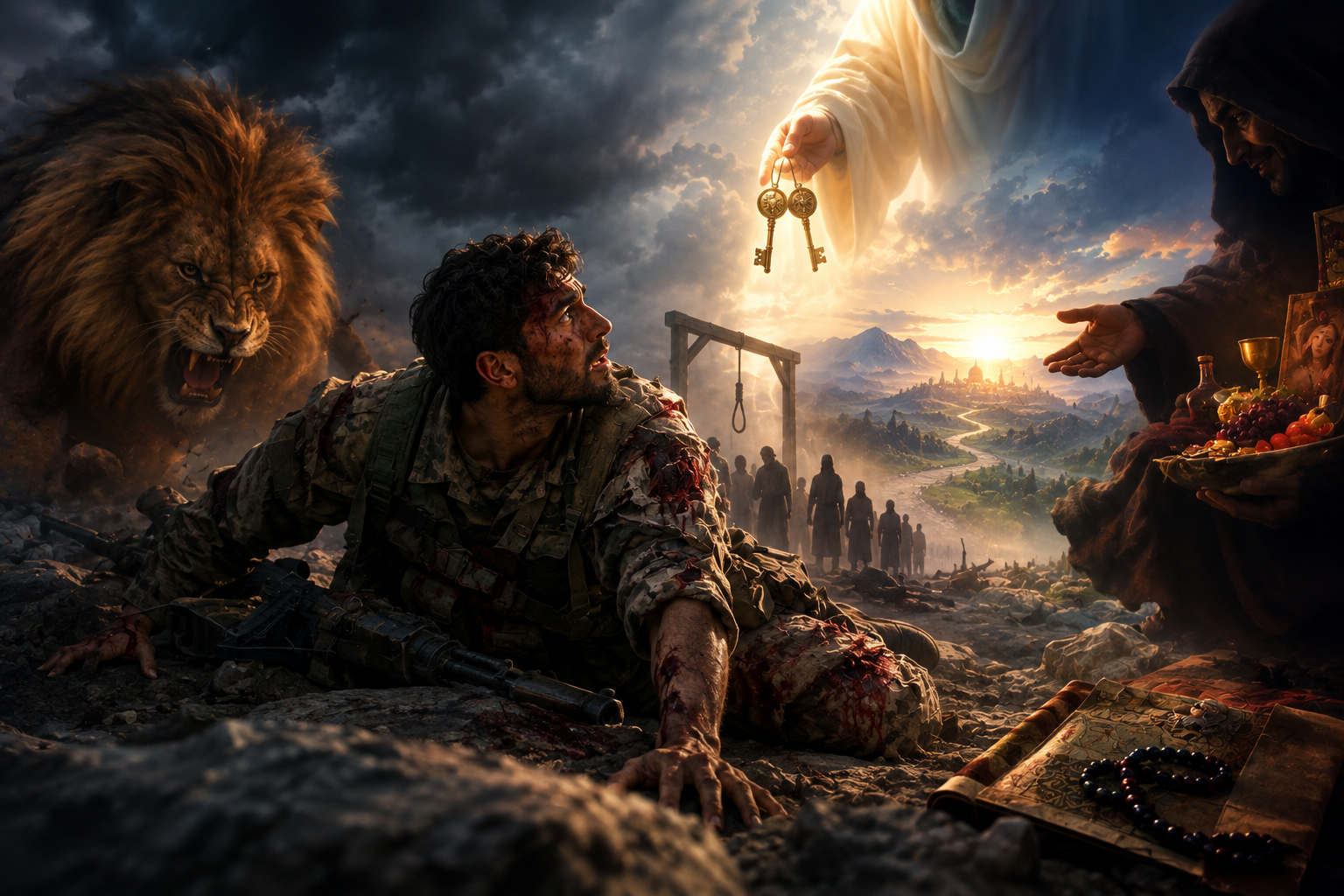
In other words, the soldier represents the human being.
- The wounds represent human weakness and need.
- The lion represents the threat of death.
- The gallows and departing loved ones represent separation and mortality.
- The unavoidable journey represents humanity's movement toward the Hereafter.
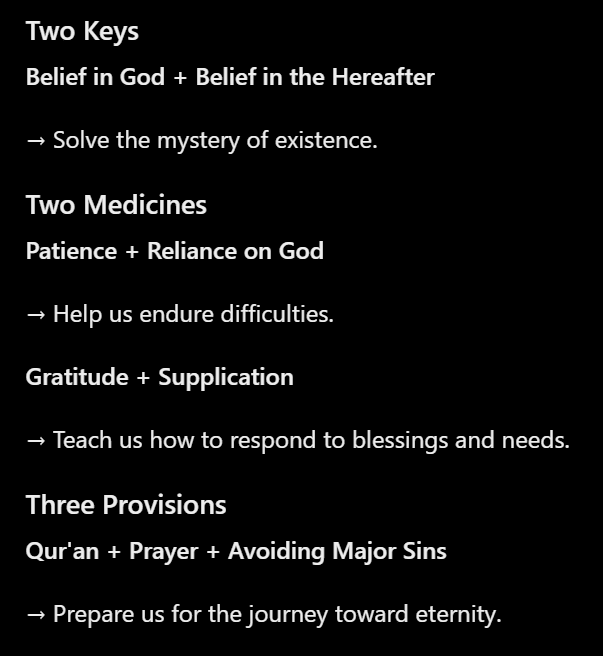
Two Great Talismans
A compassionate guide, described in the analogy like Khidr, comes to the soldier.
He gives him two extraordinary talismans:
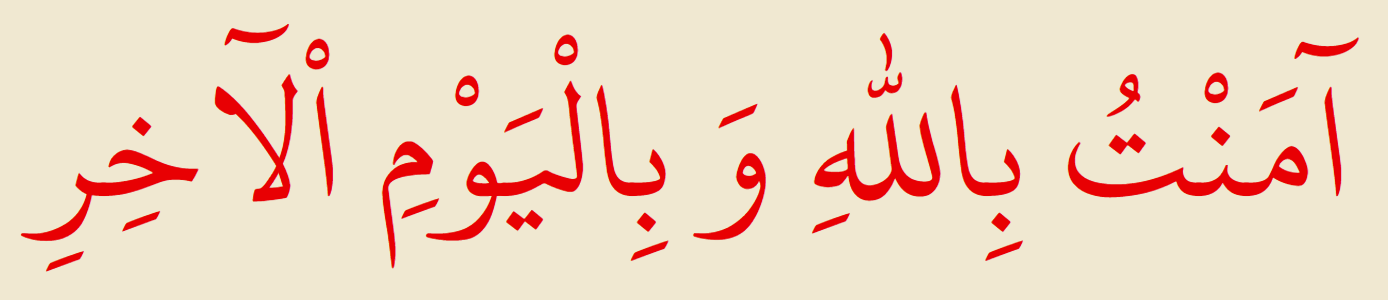
"I believe in God."
This solves the mystery of:
Where did I come from, and who is responsible for this universe and my existence ?
The universe is no longer a meaningless collection of events.
The soldier understands that there is a Creator, Owner, and Sustainer.
"I believe in the Last Day."
This solves another enormous mystery:
Where am I going ?
Death is no longer understood as simple annihilation, the journey has a destination.
Nursi therefore describes these two beliefs as keys that unlock the difficult riddle of creation and open the door of happiness for the human spirit.
Two Spiritual Medicines
The guide also gives the soldier two medicines.
The first medicine is Patience (Sabr) and Reliance on God (Tawakkul).
That is:
- patience,
- perseverance,
- reliance upon God,
- seeking refuge in Him.
Instead of believing that he must control everything himself, the believer recognizes his own weakness and relies upon his Creator.
The second medicine is Gratitude (Shukr) and Supplication (Du'a).
That means:
- gratitude for blessings,
- asking God for what one needs.
The human being recognizes:
I am needy, and God is the Provider.
So weakness becomes an occasion for turning toward God rather than simply a source of despair.
The Ticket for the Journey
The soldier is also given a ticket and provisions for his journey.
Nursi connects this with:
- listening to the Qur'an,
- obeying its commands,
- performing the prescribed prayers,
- abandoning major sins.
These become the believer's provisions for the journey to eternity and a light for the grave.
So the Seventh Word is not presenting belief as merely accepting certain propositions intellectually.
It connects belief with a way of living.
Then Comes the Tempter
Later, another man approaches the soldier.
He resembles a devilish, deceptive tempter.
He offers:
- entertainment,
- intoxicants,
- beautiful images,
- music,
- food,
- immediate worldly pleasure.
He tells the soldier, essentially:
Forget all these serious thoughts. Enjoy yourself now.
He also tries to make the soldier abandon:
- his talisman,
- his medicine,
- and his ticket.
This represents the conflict between heedlessness and guidance.
The temptation is not necessarily that worldly pleasures exist; rather, it is the temptation to become so absorbed in them that one forgets why one exists and where one is going.
Summary
The Seventh Word teaches that: